2023
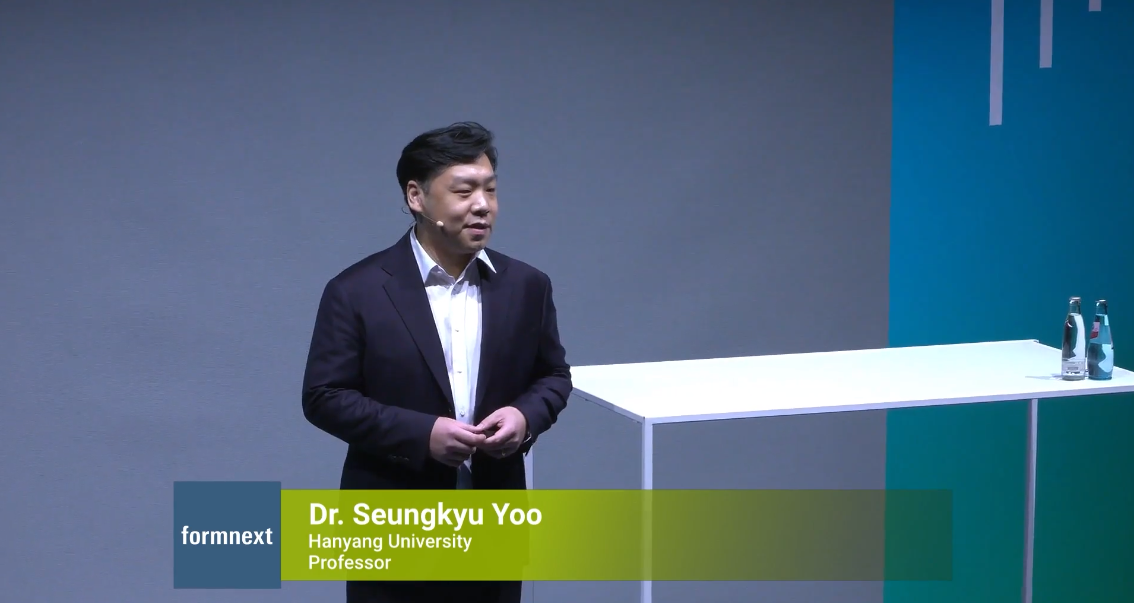
Guest Speech at FORMNEXT, 2023
Dr. Seungkyu Yoo delivered a invited lecture on the topic ‘Additive Manufacturing Business Cases in Korean Construction Industry’ at FORMNEXT 2023, Frankfurt.
Description of Presentation:
Contemporary free-form architecture, primarily in the facades of buildings and interior structural elements, is realized in limited (or simplified) forms within traditional manufacturing and production systems. This is due to the inability of existing manufacturing and production systems to accommodate the geometric diversity of free-form architecture. In such situations, we often find ourselves altering the design in ways different from the intentions of the client or architect, significantly increasing the size of components to account for errors, or selecting processing/construction methods that consume both time and cost. While these methods offer economic advantages to clients, they can result in conflicts with design quality and construction duration.
Additive manufacturing technology possesses characteristics such as expanded design freedom and small-batch, multi-product production. This represents a departure from mass production-focused manufacturing but closely aligns with the characteristics of architectural projects. Furthermore, the design freedom expansion feature of additive manufacturing allows for the realization of ideal forms pursued by architects (or clients) and enables the production of free-form architectural components that are challenging to reproduce.
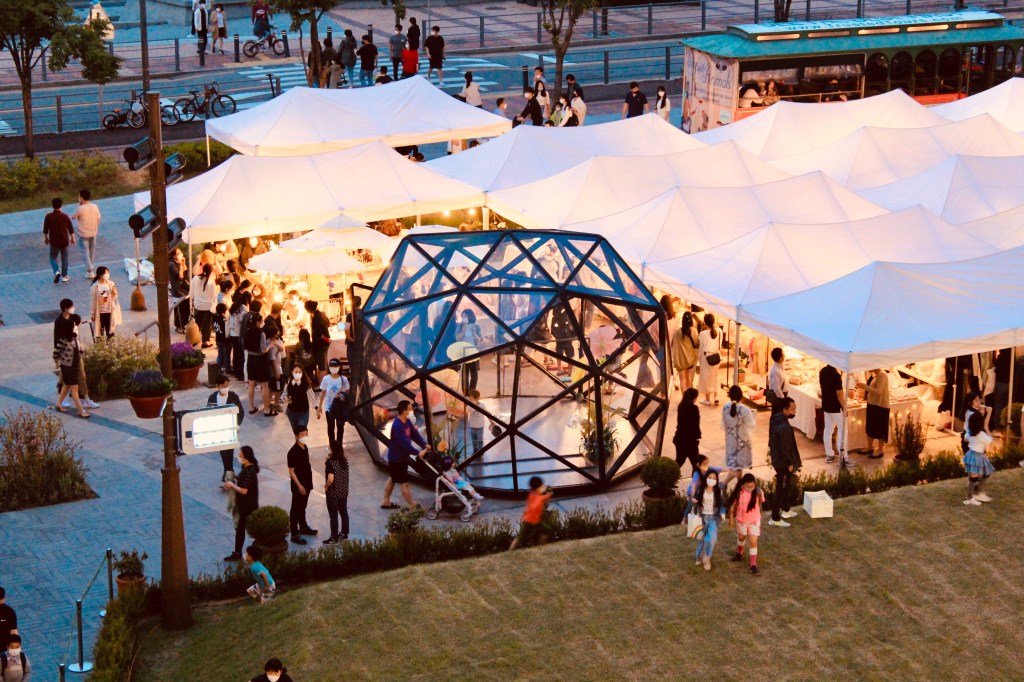
This presentation aims to share two cases where additive manufacturing technology was initially applied in the Korean construction market: the ‘Galleria Department Store Curtain Wall Project’ and the user-defined space ‘BLOBEE.’ In both cases, joint designs achieving the target shape using automated parametric design techniques were developed. This facilitated the straightforward design of numerous free-form joints, ranging from dozens to hundreds. During the production phase, various 3D printing technologies (indirect/direct additive manufacturing) were utilized to produce joints that ensured both cost-effectiveness and stability. As a result, the production of complex-shaped joints using additive manufacturing technology eliminated the impracticalities of on-site construction while significantly reducing construction time and ensuring quality.
2020
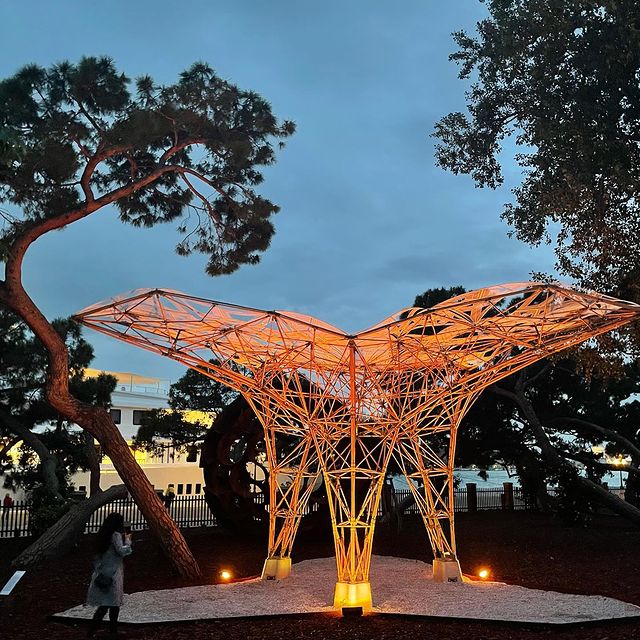
Digital Bamboo at Venice Architecture Biennale 2020
The Digital Bamboo pavilion is exhibited at the Marinaressa Gardens in Venice, Italy.
The Digital Bamboo pavilion is exhibited at the Marinaressa Gardens in Venice, Italy, during the Time Space Existence exhibition of the ECC Italy in parallel with the Biennale Architettura 2020. The ultra-lightweight structure explores the combination of bamboo with 3D printing technology. The bespoke 3D printed connections allowed the assembly of an efficient and unique structure that covers more than 40 sqm with a total weight of only 200 kgs.
Blobee
HS-Hitech Designs Atypical Buildings with HP Multi Jet Fusion Technology
Adaptive Joint System by using HP Multi Jet Fusion technology gives high structural reliability and seamless design. And this system is capable of creating aesthetic structures (e.g. interior, window, facade system, light-weight structure) incomparably faster than traditional construction methods.
Perfect customization is no more ideal thing. It is time to makes your own space.
 SEUNGKYU YOO